
The growing invasion of sargassum in the Caribbean has impacted the quality of life of the islands’ residents. But local governments have failed to coordinate an international response to problem.
Massive blooms in the spring and summer months
Schools evacuated due to toxic gas. Smelly tap water at home. Tourist operators and fishers struggling to stay in business. Job losses. Power outages affecting tens of thousands of people at a time. Dangerous health problems. Even lives lost.
Such crises were some of the consequences of sargassum in the islands of the Caribbean in 2023, and they have become common in the region since 2011 when massive blooms began inundating the shorelines in the spring and summer months.
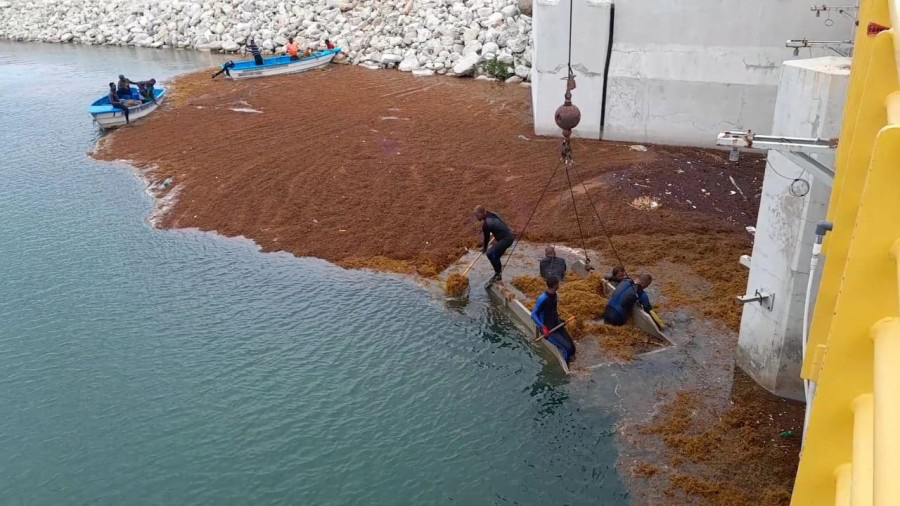
On April 18, 2023 in Guadeloupe, the air-quality monitoring agency Gwad’Air advised vulnerable people to leave some areas because of toxic levels of gas produced by sargassum. Six weeks later, about 600 miles to the northwest, sargassum blocked an intake pipe at an electricity plant at Punta Catalina in the Dominican Republic. One of the facility’s units was forced to temporarily shut down, and a 20-year-old diver named ElÃas Poling later drowned while trying to fix the problem.
British Virgin Islands (BVI)
In the British Virgin Islands (BVI), most of Virgin Gorda’s 4,000 residents had to deal with sporadic water shutoffs and odorous tap water for weeks after sargassum was sucked into their main desalination plant last August.
And in Puerto Rico, a highly unusual late-season influx inundated the beaches of the Aguadilla area for the first time, leaving residents like Christian Natal and many others out of work for a week when it shut down businesses including the jet ski rental company that employs him.
These victims are among thousands of people hurt by sargassum blooms last year alone in the Caribbean, where about 70% of the population of around 44 million lives near the coast, according to the World Bank.
Scientists blame the explosive growth of the seaweed on global pollution, climate change, and other international problems that Caribbean islands did little to cause and lack the political power to resolve.
“Seaweed must be seen as an impact of global warming, with the opening up of the right to compensation on the grounds that we are small, vulnerable islands,†said Sylvie Gustave dit Duflo, the vice-president of the Guadeloupe Region in charge of environmental issues and president of the French Biodiversity Office.
She added that the countries of the Caribbean Community (CARICOM) — which include 15 member states and five associate members that are territories or colonies — recorded economic losses of about $102 million due to sargassum in 2022 alone.
.
“Sometimes, the boats can’t even come into the creek,†said Jamaican fisherman Richard Osbourne. “It blocks the whole channel.â€
Oceans know no boundariesÂ
That much was clear by 2018, when the belt grew to a record size that was estimated at 22 million tons and much of the Caribbean saw its worst-ever inundation. The season spurred increasing calls for a collaborative international response.
The following year, United Nations Secretary General Antonio Guterres visited St. Lucia for a July meeting of the Caribbean Community, and he took a side trip to the small fishing village of Praslin Bay.
Surrounded by dignitaries, Guterres walked down a dock lined with small boats bobbing atop thick mats of sargassum, which for years had plagued fishers, sea moss farmers and other residents in the area.
“So it’s a terrible scene for the people?†he asked a resident in a video posted on the United Nations website.
“Yes,†the man responded. “It’s killing the fishes in the bay. The stench. It’s destroying our electronics because of the fumes.â€
After his visit, Guterres described his sadness on seeing a “landscape that resembled an algae desert for hundreds of meters.â€
Then he called for international action.
“Oceans don’t know borders, nor does climate,†he said. “It is a global collective responsibility to take action now.â€
But that broad international action has not materialized as planned. Despite a growing patchwork of studies and projects across the region, various attempts by the UN and others to coordinate a Caribbean-wide response have been largely stalled by funding shortages, geopolitical issues, the Covid-19 pandemic and other factors.
One of the most extensive efforts came about three months after Guterres’ visit to St. Lucia, when Guadeloupe hosted the First International Conference on Sargassum in October 2019. Partners at the event — where the three-year Sarg’Coop program financed by about $3.2 million in European Union funds was officially launched — included the French government, the Guadeloupe Region, UNESCO and other entities. In attendance were representatives from more than a dozen Caribbean countries and territories, as well as the US, Mexico, Brazil and France.
Some progress followed. For instance, the Guadeloupe Region — in partnership with the French government, the French National Research Agency and two Brazilian agencies — launched a call for projects that enabled a dozen international studies to be carried out on the health, environmental and economic impact of the seaweed, as well as possible uses for it.
Other regional meetings have been held since then as well. Last June, for instance, an European Union-Caribbean conference on “Turning Sargassum into Opportunity†was held in the Dominican Republic, and the topic was discussed the following month at a summit of the EU and the Community of Latin American and Caribbean States (EU-CELAC) in Brussels, Belgium.
But almost five years after the 2019 Guadeloupe conference, the broader goals have not come to fruition on a regional level as envisioned, experts acknowledge. No Caribbean strategy is in place, and the region-wide warning and monitoring center envisioned at the conference has not been established.
The 2023 sargassum bloom in the Caribbean had mostly abated by Dec. 2, when Gustave dit Duflo, the French Biodiversity Office president, stood at a podium 8,000 miles away during a side event at the COP28 meeting in Dubai.
She then explained the French government’s proposal to address the issue. The program, she said, has four prongs: forming an international coalition to better understand the problem and its causes; addressing sargassum in international forums like the COP of Biodiversity; acting in the framework of the Cartagena Convention; and working with the EU to support the continuation of the regional Sarg’Coop project launched during the 2019 conference in Guadeloupe.
The French government has presented the proposal as an unprecedented move at COP 28, with the aim of placing the sargassum issue on one of the high-level panels of the United Nations Conference on the Oceans to be held in Nice, France, in June 2025.
Such collaboration is essential, according to Gustave dit Duflo.
“We manage sargassum at a local level, but this is not a phenomenon of an island. It is the whole basin of the Caribbean and a part of the Atlantic,†she said. “This is why all the countries that are impacted, we need to create an international coalition to be able to find means and ways to act.â€
Since COP28, the Netherlands and its overseas countries and territories decided to join the international program proposed by France alongside Costa Rica, Mexico, Dominican Republic and the Organisation of Eastern Caribbean States, Gustave dit Duflo told CPI.
A meeting will be held soon with the European Commission to define the project’s legal guidelines and financing, she said.
Also at COP 28, the EU and the government of the Dominican Republic co-organized a related panel at the Dominican Republic pavilion, where they launched an initiative to “turn sargassum into an economic opportunity†by tapping the EU-Latin America and the Caribbean Global Gateway Investment Agenda.
To succeed, such projects will need to build on work that came out of efforts like the 2019 conference in Guadeloupe — and overcome the challenges that delayed them.
You can read the full article from Inside Climate News here.