
Article posted by The Revelator  May 3, 2024 – by Maria Mónica Monsalve (América Futura, El PaÃs América) and Krista Campbell (Television Jamaica)
For more than 20 years, Mexican biologist MarÃa del Carmen GarcÃa Rivas has led a crusade to protect the coral lining the Yucatan Peninsula in the Caribbean Sea.
As director of the Puerto Morelos Reefs National Park in México, she has advocated for reforms to reduce runoff and other pollution from coastal development.
She has spearheaded efforts to control lionfish, an introduced species that has put at risk the nearly 670 species of marine fauna that inhabit the park. And since 2018, she has organized brigades to restore reefs damaged by tissue-destroying coral diseases known as white syndromes. But now, yet another threat has been keeping her awake at night: massive blooms of sargassum seaweed reaching the coast of the park.
Regional Problem
This story is familiar across the Caribbean. Though modest amounts of sargassum benefit marine life in the region, massive influxes arriving since 2011 have upset the ecological balance in some areas in ways that could be irreversible. Scientists blame the explosive growth of the seaweed on global pollution, climate change, and other international problems that Caribbean islands did little to cause and lack the political power to resolve.
The seaweed has exacerbated existing stress on the region’s reefs, which last year faced a massive bleaching event linked also to warming waters associated with climate change. Exposure to extreme temperatures for extended periods breaks down the relationship between the corals and the algae living inside of them. Corals are left pale or white, and the lack of food from algae can lead them to die, according to the United States National Oceanic and Atmospheric Administration.
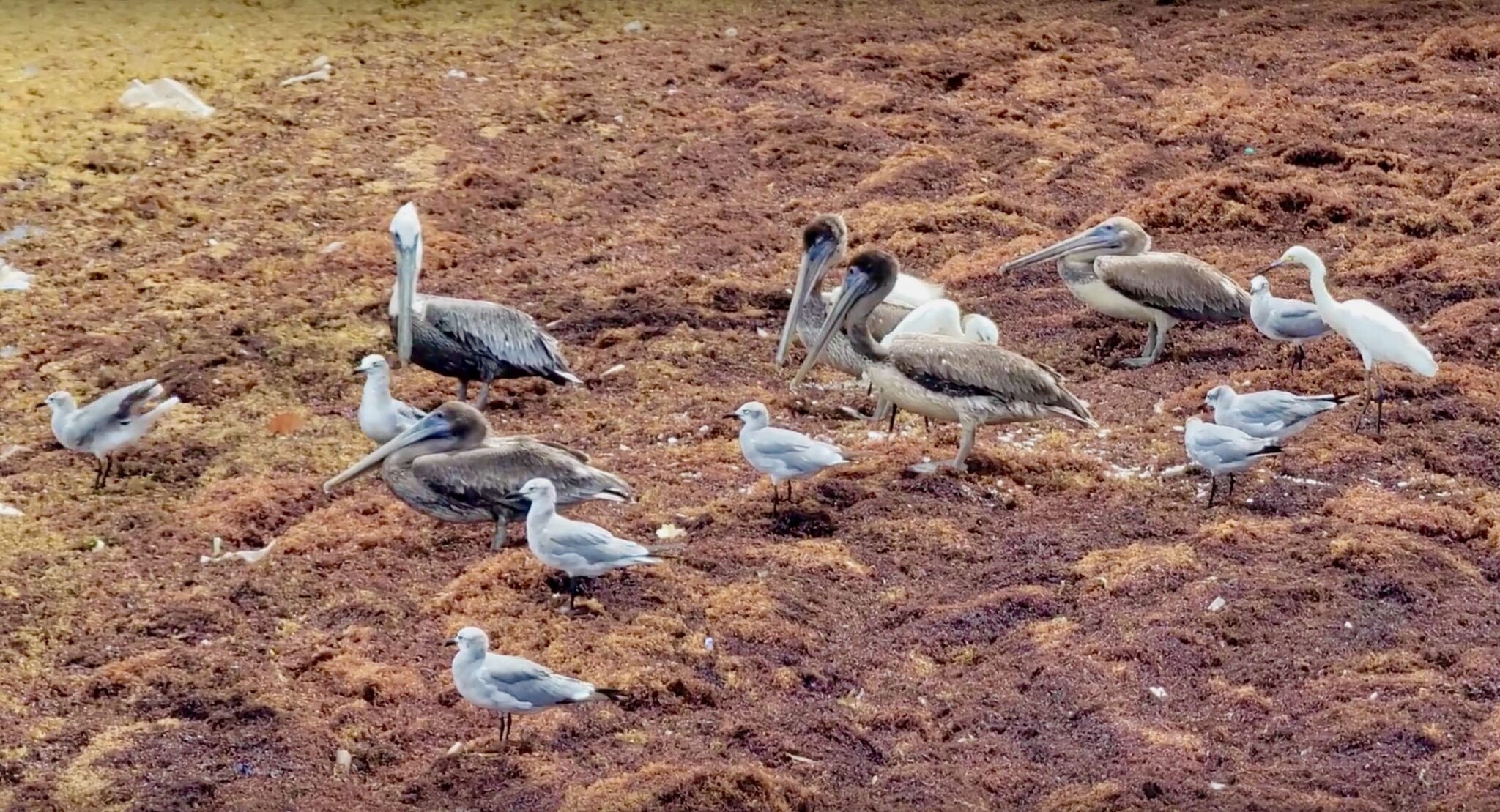
Sargassum mats have also blocked sea turtle nesting sites and inundated mangroves, which serve as crucial nurseries for countless aquatic species.
These efforts demonstrate that sargassum has immense potential as a resource, benefiting industries ranging from agriculture to energy.
Bacterial Diseases
In addition, GarcÃa Rivas said, bacteria carried by the sargassum may be affecting the corals as well.
“Some of the diseases suffered by the corals could be related to all the bacteria brought in by the sargassum or that arise during its decomposition,†she said. “Although it becomes an environment without oxygen, there are bacteria that may be able to survive, affecting not only the corals but also generating fish mortality.â€
Such effects exacerbate existing threats to the reef, she said, noting that the worst historical damage has come from coastal development and inadequate management of sewage and other waste.
A similar scenario has played out in Jamaica, according to Dr. Camilo Trench, a marine biologist at the University of the West Indies in Jamaica.
“The problem is that the seaweed grows fast and the corals grow slowly,†Trench said. “So if the sargassum is in the area with other macroalgae, it can overgrow the coral reef area quite quickly. So now it will not only reduce the space that the corals will have to grow: It will also reduce the settlement area of the coral nursery.â€
"In general, contaminated seawater does not allow corals to live properly,†she said. “It weakens them. And when they present diseases or are stressed by heat, it is easier for them to die."
Sargassum also appears to have a potentially lethal impact on Caribbean mangroves, an important natural barrier for extreme hurricanes.
Local Government Looks for Solutions
Faced with this problem, last year the state of Quintana Roo created a committee of 60 experts from different areas that worked for seven months to help create what is now known as the Integral Strategy for the Management and Use of Sargassum in Quintana Roo.
The strategy covers eight areas: health; research and monitoring; knowledge management, processes and logistics; utilization; legal framework; economic instruments and cross-cutting axes. Its key advances include designating the state of Quintana Roo as the authority in charge of granting permits to researchers and companies working to turn sargassum into a product.
“The state government is the one that gives all the permits for issues ranging from transportation, collection to final destination. With that we avoid that companies are going around in circles between whether to ask the federal or municipal government where to acquire the permits,†said Hernández Gómez, the ecology and environment secretary.
The response is costly. Last year, she said, the Secretariat of the Navy was assigned about $3 million to collect sargassum at sea using its ships and anchorage barriers, while the Federal Maritime Terrestrial Zone was assigned about $7 million more to collect it from beaches. In Quintana Roo, through the Secretariat headed by Hernandez Gómez, another $1.7 million is coming in to address the problem.
“And this year that investment will be maintained,†she said.
You can read the full article posted by The Revelator  May 3, 2024 – by Maria Mónica Monsalve (América Futura, El PaÃs América) and Krista Campbell (Television Jamaica)
Originally published by CBC.ca, article by · CBC News ·
Every winter, millions of Canadians head down to the Caribbean in search of sunshine, pristine beaches and crystal-clear waters.
This year, however, tourists may have noticed something not-so-pleasant awaiting them on the beach: stinky, brown sargassum.
Over the past decade, the foul-smelling seaweed has become more common on beaches around the Caribbean and the south Atlantic Ocean. So what’s going on? To understand, first you need to understand sargassum.
What is sargassum?
Sargassum is a type of brown seaweed (and a form of algae) found in the Atlantic Ocean. It is made up of leafy pieces, as well as oxygen-filled, round berry-like bits that help it float on the surface. It doesn’t have any roots or seeds.
Unlike some other types of seaweed, it lives its entire life on the surface of the ocean in small patches. Sargassum is usually found in a region called the Sargasso Sea, where it tends to circulate in a vortex called a gyre, through a five-million square kilometre belt that runs from Chesapeake Bay in the mid-Atlantic, all the way to the Caribbean.
However, sargassum can clump together, creating rafts or or patches. It has a seasonal cycle, beginning in the spring, reaching its peak in the summer, and finally dying off in the fall.
Sometimes large collections can wash up on beaches, which can be an annoyance to beach-goers. But they’re vital to some marine life, providing food and breeding grounds for animals such as fish, sea turtles and more.
“[Sargassum] has formed these enormous floating masses in the open sea, which are wonderful, actually … because they soak up carbon, they suck up nutrients, they sustain a lot of life, and a lot of animals depend on them,” said Brigitta Ine van Tussenbroek, a scientist at the National Autonomous University of Mexico’s Institute of Marine Sciences and Limnology.
“Even the American eel, the Northern European eel, they wouldn’t exist without the Sargasso Sea, for example. So it’s a wonderful system.”
Is it increasing?
While most sargassum usually remains in this gyre, it can travel along a sort of conveyor belt in the Atlantic and Caribbean. Scientists have seen a noticeable increase in sargassum washing up on beaches in the Caribbean since 2011.
“Sometimes, some of these gyres … slackened, and some of the sargassum escaped and then went to Cuba, to Hispaniola, and some ended up in Mexico pass to the Gulf of Mexico. And then it went back to the Sargasso Sea,” van Tussenbroek said.
“Since 2010–11, suddenly, some sargassum started to accumulate in a new area, which is just north of the equator in the tropical Atlantic.”
A number of factors could be at play, including climate change and human activity, Â said van Tussenbroek.Â
Chuanmin Hu, a professor at University of South Florida who studies these blooms with their Sargassum Watch System (SaWS), said that a lot of nutrients come from the Saharan Desert dust that blows across the Atlantic Ocean.
But there’s also ocean upwelling, he said, where water from deep below the ocean is brought to the surface, and along with it, more nutrients, which further supports these blooms. And, scientists believe that with a changing climate, there could be more ocean upwelling. As well, nutrients flow into the Atlantic from the Congo River in Africa and the Amazon River in South America.
“Now the question is, which is dominant?” Hu said. “We just don’t know. It’s difficult to quantify their contributions.”
Just how much is there?
In January, there were more than eight million metric tons of sargassum in the Atlantic Ocean, Hu said. In February, that dropped to between six-to-seven million metric tons. But Hu said there could be even more in March.
“Right now they’re scattered here and here with a low density. Even within the belt, the density is of less than 0.1 per cent,” Hu said. “But if somebody could put all the sargassum in one place, what is the size of this? It’s about, I think, 3,000 square kilometres, with no gap.”
An abundance of sargassum can threaten delicate shoreline ecosystems, as well as smother coral reefs, reducing their cover and roughness, which makes them more susceptible to waves and have less protection from hurricanes. It can also prevent hatchling sea turtles from reaching the ocean.
The good news is that there could be some uses for the masses of sargassum, including using it as biofuel or even as building materials.
Originally published by CBC.ca, article by · CBC News ·